 |
| PAPA
WESTRAY --- PAPAY --- PAPEY IN MEIRI |
| PAPAY
is a local name of the island PAPA WESTRAY - one of the most remote
Northern Isles of Orkney, and journey to Papay can be as exiting as
journey to the Moon. The Island is 4 miles long and 1 mile wide with
lash green treeless hills and stone houses, ruins of great samples
of vernacular architecture and historical monuments scattered around
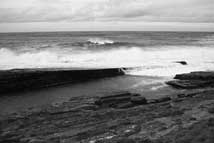
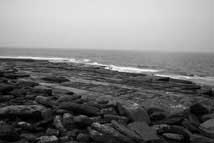
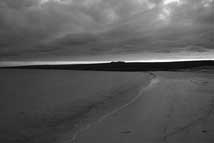
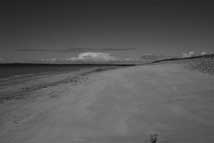
and the coastline of sea-cliffs, flat rocks and sandy beaches. Northern
Sea meets Atlantic here at the northern tip of the island - Mull Head
and North Hill is a busy nesting ground for a variety of sea birds.
The first know house on the Island, Knap of Howar, was build 6000
years ago and the history can be traced from there through Neolithic
sites (Chambered Cairn on Holm of Papay), numerous ruins of Pictish
brochs (Munkerhoose and St.Tredwell), Norse Placenames and Nausts
all around the island, 12 century St. Boniface Kirk, St. Tredwell
Chapel, Holland Farm, other landmarks and the Island's Legends |
| PAPAY
is also known as PAPEY IN MEIRI
in the Orkneyinga Saga |
 |
| HISTORY |
|
3500BC
Knap of Howar - the oldest preserved house in northern
Europe |
|
8c.
Nechtan and Triduana
in
the 8th century, the Pictish King Nechtan visited Papay and attempted
to seduce a young woman from the island named Triduana, who in response
gouged her own eyes out.
Nechtan was known as the King Philosopher. He abdicated in 724 and
became a monk. Triduana became saint and chapel St. Tredwell was build
in Papay, the place of pilgrimage for many centuries. It seems Nechtan
and Triduana could be a nice couple, but the King was a pagan at that
time. Triduana was a nun. It looks like ugly sisters couldn't let
it happen and helped a lot in reapping out Triduana's eyes and presenting
in to the King. Since 8th century no other cases of similar self harm
were recorded in Papay |
|
8c.
Findan, having been captured by a Viking slave-raiding party
who had stopped on a small, uninhabited island, escaped to a larger
island close by, where he took refuge with a bishop; Thomson has suggested
the two islands could be the Holm of Papay and Papay itself (Thomson
1986, 280-3; Lowe 1998, 8-9; Thomson 2001, 50). Lamb has also seen
the island as the seat of a ninth- century bishop |
|
11c
Rognvald Brusason (born 1011 - died 1046), son of Brusi Sigurdsson,
was Earl of Orkney jointly with Thorfinn Sigurdsson from about 1037
onwards
Rognvald was taken by his father to Norway, to the court of Olaf Haraldsson,
when Brusi and Thorfinn went there to have the inheritance of Einar
Wry-mouth's third-share of the Earldom settled. Olaf kept Einar's
share for himself, appointing Brusi to administer it, and kept Rognvald
at his court.
The Orkneyinga Saga says of Rognvald: Rognvald was one of the handsomest
of men, with a fine head of golden hair, smooth as silk. At an early
age he grew to be tall and strong, earning a great reputation for
his shrewdness and courtesy...
Rognvald was a supporter of Olaf Haraldsson, later Saint Olaf, sharing
his exile in Kievan Rus, and helping his brother Harald Sigurdsson,
better known as Harald Hardraade, escape after the Battle of Stiklestad
in 1030. While Harald went on to Constantinople, Rognvald and other
exiles remained in Rus, in the service of Yaroslav the Wise. Rognvald
returned to Norway with Olaf's son Magnus the Good in 1035.
While Rognvald was abroad, his father had died and Thorfinn Sigurdsson
was ruling all of the Earldom of Orkney. Rognvald asked King Magnus
for his third part of the Earldom, and Magnus agreed, giving him three
ships and granting him the stewardship of Magnus's own third share.
When Rognvald arrived in Orkney, he sent to his uncle Thorfinn asking
him for the two thirds of the Earldom which Magnus had given him.
Thorfinn agreed to give Rognvald his father's third, and the third
which Magnus claimed into the bargain, although he claimed not to
recognise Magnus's claim and presented this as a gift in return for
Rognvald's assistance. and Rognvald worked closely together for eight
years, fighting against enemies in the Hebrides and raiding Scotland
and England
He was murdered in Papa Stronsey and buried in Papa Westray.
The Orkneyinga Saga offers this assessment of Rognvald:
Everyone agrees that of all the Earls of Orkney he was the most popular
and gifted, and his death was mourned by many. |
|
12c
In the twelfth century the ‘great lady’ and ‘wise
woman’ called Ragna and her son, Thorstein,
‘a man of fine character’ had an estate in Papa Westray,
although they seem to have lived in North Ronaldsay (Orkneyinga Saga,
Taylor,218,246). This estate was probably to the south east of Holland,
comprising the farms of Backaskaill and Breckaskaill which were believed
by Clouston to make up the bu of Ragna and Thorstein,:
- the two names perhaps indicating the splitting of an early udal
property (probably called originally Skaill) between two heirs (Clouston
1927, 49; Marwick 1952, 45) Although there are now no surface indications,
an old settlement site lying between the two extant farms is known
to have existed (RCAHMS 1983, 14, no. 12; NMRS no. HY45SE41, OR 787,
HY 4862 5085). Backaskail forms the main landing place on the west
side of the island (Marwick 1925, 44; Marwick 1952, 45). |
|
1472
Orkney annexed to the Scottish Crown, following the failed payment
of a dowry for James III's bride, Margaret of Denmark |
|
1588
Survivals from one of the Spanish Armada' ships wrecked near North
Ronaldsay established a settlment in Westray and as a legend goes
buried a treasure at North Hill in Papay |
|
16c
Sometime prior to 1595, the king’s land in Papay had been feued
out to the deceased Gilbert Balfour of Westray (Marwick
1925, 44). |
|
17c
In 1614, the leading families were Leasks and Howisons |
|
1636
Thomas Traill purchased the estate of Holland in
Papa Westray and by the eighteenth century Traills
were the sole landowners on the island |
|
1813
The last Great Auk being killed by local man William Foulis
an Fowl Craig. |
|
1909
John D. Mackay (1909, Maeback,
Papa Westray, Orkney), Orcadian school-teacher, taught on Stronsay
and North Ronaldsay before working as headmaster of Sanday School
between 1946 to 1970.
He
is remembered locally for writing to The Times in 1967 suggesting
that Orkney and Shetland be returned to Norway after five centuries
in pawn to Scotland. His letter brought publicity to Orkney and boosted
some residents' morale, at a time when absorption into the administrative
structure of the Scottish Highlands seemed destined to cause a reduction
in the powers of the local authorities. A stream of local publicity
efforts followed. |
|
| 1917 |
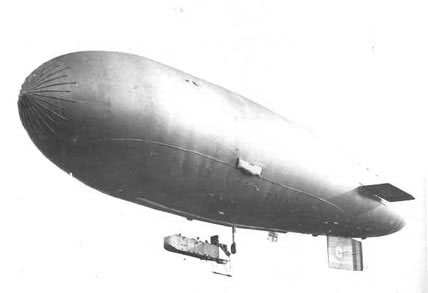 |
The
loss of the Airships SSP 2
Airship SSP 2 left Caldale for operations to the north of the Orkney
Islands at 08.50 on the morning of 26th November 1917. The weather
on the day was considered favourable.
On board were:
Pilot Ft Lt Edward Bourchier Devereux
Engineer AM 1 Albert Edwin Scott
W/T LM (W/T) Edgar James Wilson.
By 10.00 the winds had freshened and the Airship, which was 17 miles
NNW of the base sent a radio message saying she was intending to return
to base and giving an ETA of 10.30. Ft Lt Devereux brought SSP 2 down
to 200 feet hoping to find lighter winds. Things appear to be going
ok with regular messages being sent back to base, one at 10.30 giving
a new ETA of 11.30 and an update saying wind had increased to 30 knots.
At 11.20 the SSP 2 reported engine failure and was going to make a
free balloon landing in the sea to the NE of Papa Westray and requested
assistance.
HMS Leopard and several drifters were patrolling in the area and at
11.40 a lookout on HMS Leopard reports seeing an Airship land on the
sea then explode. Despite a search which went well on into the evening
nothing of the crew or airship was found |
|
| ..
more history is coming soon |
|
|
| |
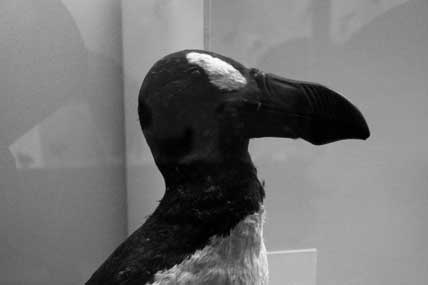 |
| At
the northern tip of the island lies North Hill 49 metres (161 ft)
the island's highest point and an RSPB nature reserve. Many sea birds
breed on the island, including Arctic terns and Arctic skuas. It was
one of the last places where the Great Auk was found, the last individual
being killed in 1813 by local man William Foulis an Fowl Craig. The
reserve is also home to the rare and tiny purpled-flowered Mey-flooer
(Scottish primrose Primula Scotica) |
|
| KNAP
OF HOWAR |
 |
|
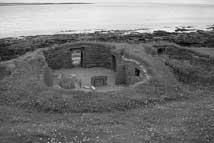
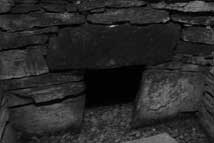
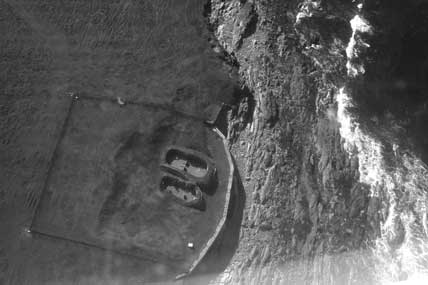
| The
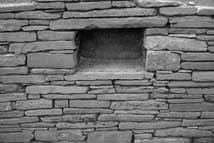
Knap of Howar Neolithic farmstead which is the oldest preserved house
in northern Europe, dating from around 3500 BC. The homestead, which
consists of two roughly rectangular stone rooms side by side, linked
by an internal door, and with doors to the outside at the west end,
is partly subterranean, and virtually complete to roof height. Examples
of the round bottomed Unstan ware have been found here, and provided
the key to dating the settlement. |
|
| ST
TREDWELL CHAPEL & BROCH |
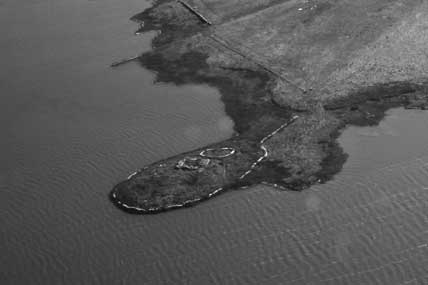 |
According
to tradition, in the 8th century, the Pictish King Nechtan attempted
to seduce a young woman from the island named Triduana, who in response
gouged her own eyes out. She later became abbess of a nunnery at Restalrig,
now part of Edinburgh, and was in due course, canonised as Saint Tredwell.
A chapel was consecrated to her on Papay and became a place of pilgrimage
for people with eye complaints.
The Chapel was build on the ruins of Pictish Broch traces of which
can be well seen |
|
| ST.
BONIFACE KIRK |
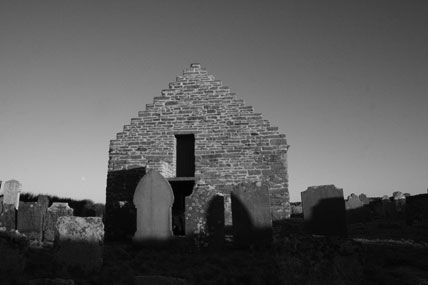 |
St
Magnus cathedral in Kirkwall and the little church of St Boniface
on Papa Westray – one of the smallest and most northerly islands
of the Orkney archipelago – are the only two medieval churches
in Orkney which have survived into the 21st century intact and still
in use for worship.
A late 7th-century incised cross found in the kirkyard at St Boniface
is the earliest piece of hard evidence that Christianity had arrived
in the Northern Isles. Although Papa Westray seems remote when viewed
from the modern perspective of motor-car based communications, for
all the previous centuries of sea travel it was on a main highway.
It is likely that the first church on the island was part of a monastery,
built as springboard for missionary expeditions to both Orkney and
Shetland.
Sometime in the 12th century St Boniface became the parish church,
as it remained for 800 years until 1929 when it became redundant and
was abandoned. For the next 60 years the little stone church and its
unusual early 18th-century furnishings slid into dereliction until
at last restoration was undertaken by a team of local builders. In
June 1994 St Boniface was rededicated (after a pilgrimage around the
historic places of the island which has become an annual event) and
is used again for occasional services.
Surrounded by fields and the sea, it is a peaceful place; the only
sounds one usually hears there are the wind, the waves crashing on
the shore below, or birdsongon a summer evening. The remarkably good
acoustic makes it an ideal place for concerts (even if the performers
sometimes have to contend with the Orkney wind!): Emma Kirkby and
Anthony Rooley have performed Dowland and Monteverdi, and in August
2007 Alfia A performed her “Bach marathon”, the six suites,
in its intimate small space and realised it was where she wanted to
record them. |
| Jocelin
Rendall, 2008 |
|
| HOLM
of PAPAY with CHAMBERED CAIRN |
 |
|
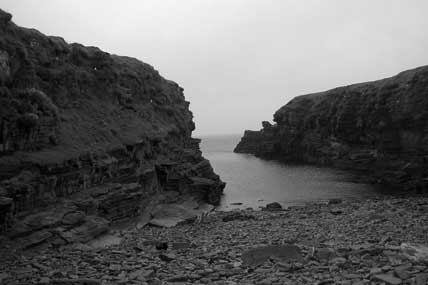
| Neolithic
chambered cairn on the small desert island of Holm of Papay, a little
east of Papay itself (and readily visible from the larger island).
The long, stalled cairn, built of local stone, was once a communal
burial place for the bones of an ancient community. |
|
| NAUSTS
OF PAPAY |
Boat
nausts-unroofed or roofed boat shelters contrived on or above the
shoreline with an attendant slipway and landing place-is well attested
for the Norse period and earlier in Norway.
About 18 nausts sites were established on the shoreline of Papay
More information on Nausts of Papay can be found in The lniernaiional
Journal of Nautical Archaeology and Underwater Exploration (1990)
19.4: 3 17-325. Boat naust survey on Papa Westray, Orkney by Anne
Bowman |
|
| HOLLAND
FARM and FOLK MUSEUM |
 |
|
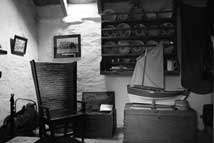
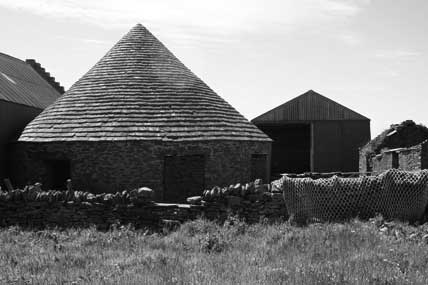
Formerly
the home of the Trail family, lairds of the island for three centuries,
this is perhapsthe most extensive traditional steading in Orkney.
It features a doo'cot, mill tramp and corn-drying kiln. Small Museum
at old Bothy, created by John o' Holland, is a great collection of
Papay artefacts and guide into the island's history
About the history of Holland Farm and Papay read:
A Jar of Seed Corn: Portrait of an Island Farm by Jocelyn Rendall,
Orcadian Ltd 2002, ISBN-10: 1902957164. A fascinating, well-researched
work on the history of Holland farm which also tells the story of
the island and its people. Once home to a powerful land-owning dynasty
that crashed into spectacular bankruptcy, Holland embodies the history
of Papay since medieval times. Full of pictures and intriguing details
this is an engaging account of the island's evolution from virtual
feudalism (as recently as Victorian times) to today's fragile but
independent and egalitarian community |
|
| THE
OLD KELP STORE |
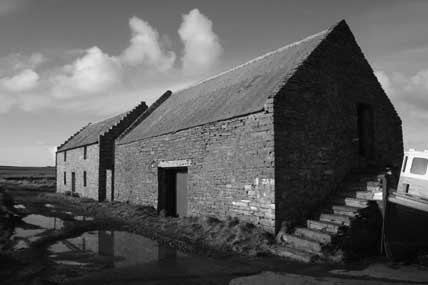 |
In
several parts of the island one can see shallow, circular depressions
near the shore. These are kelp kilns, the only sign of an industry
that domonated the Orkney economy in the late 18th and early 19th
centuries.
The two-storey buildings near the old pier on the east side of the
island were originally kelp stores and the enclosure at the head of
the pier was a boathouse for the "Mary Traill" which transported
the kelp... |
Jocelin
Rendall. Papay - A Guide to Places of Interest. Papay Publications
1992
ISBN 1-874755-02-7 |
|
| THE
OLD PIER |
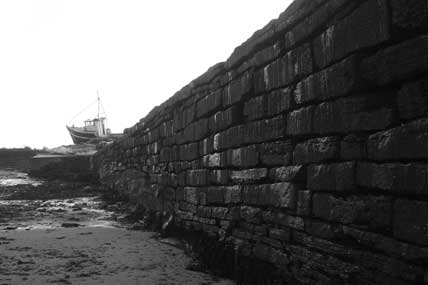 |
| Before
the new pier was build in 1970, cargo was transported once a week
to the old pier. The old pier is still busy with local boats and as
a link with Holm of Papay |
|
| THE
WATERMILL |
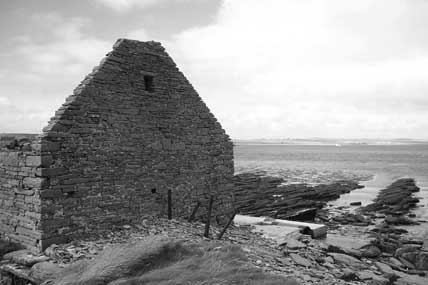 |
| There
has been a watermill on the narrow neck of land between St. Tredwell's
Loch andthe sea since the early 17th century. |
Jocelin
Rendall. Papay - A Guide to Places of Interest. Papay Publications
1992.
ISBN 1-874755-02-7 |
|
| CARSIES |
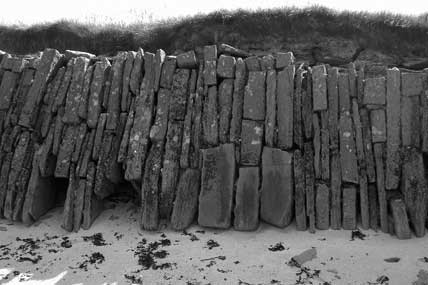 |
| Carsies
used to protect the shors of Papay from the sea erossion. Now only
small fragmets of carsies are remaining and bigges fragment can be
seen next to the Watermill |
|
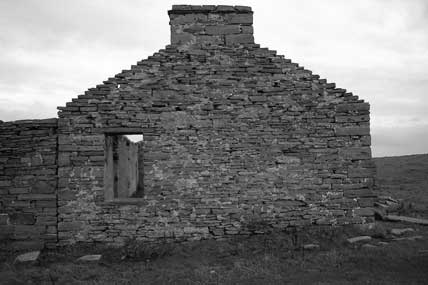
| SAMPLES
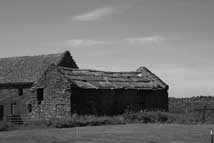
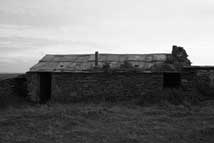
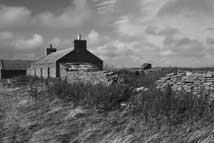
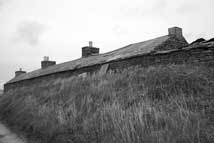
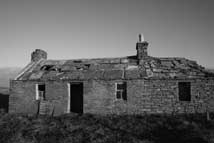
OF VERNACULAR ARCHITECTURE |
 |
|
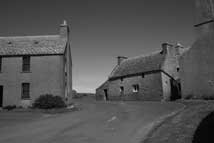
Fine
samples of traditional stone buildings with flag stone roofs can be
seen around the island - some are abandoned and derelict, some are
inhabited for hundreds of years and well kept without much changes,
some are carefuly restored
Some house names from Papay census 1851:
Hundland
Ness
Gowrie
Whitelooms
Stripes
Clestran
Newbiggin
Quoise
Nort Via
Sooth Via
Breck
Hinsobreck
Cott
Midhoos
Shorehoos
Maybo
Skeness
Sunibraes
Newhouse
Nouster
Daybreck
Manse
Links
Hookin
Quarryhoos
Dykeside
Bilbo
Schoolhouse
Holland
Bolisbel
Edgeriggs
Brecaskail
Garbols
Bacaskaill
Hindbrae
Peatwall
Rendall
Quoyolie
Myrie
Whitehowe
Gayfield
Nistaben
Vestness |
|
| CRUES,
SOUTH OF FOWL CRAIG |
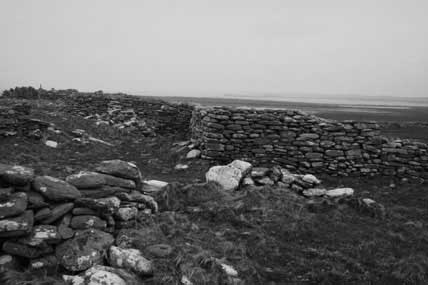 |
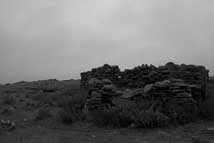
| Ruins
of the crues - small walled enclosures used for growing vegetables
and penning geese are creating an athmophers of an abandon ancient
city |
|
| FOWL
CRAIG |
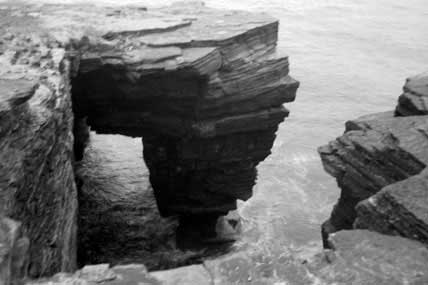 |
| A
sculptural cliffs of Fowl Craig are nesting ground for puffins and
the place where in 1813 the last Great Auk was killed |
|
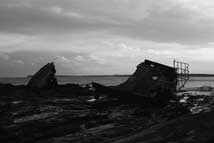
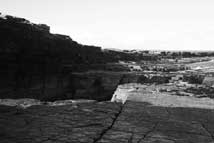
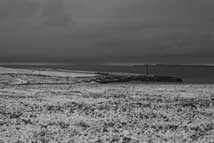
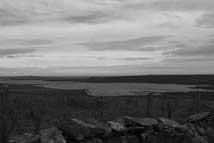
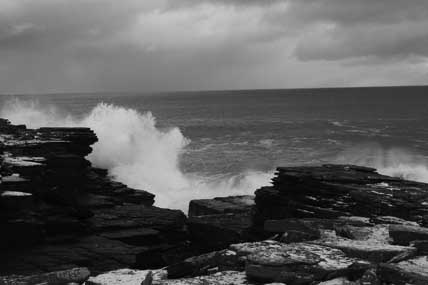
| COAST
AND LANDSCAPE |
 |
|
|
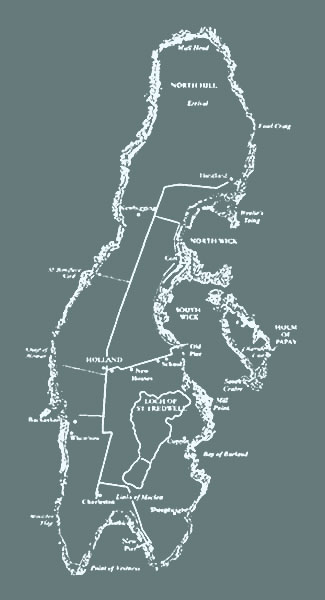
| MAP |
| |
|
To
see Papay in full colour and to find out more about the island please
book a Papay Peedie Tour with Jim Rendall through the Papay Co-Op.
T. +44(0)1857 640 340
MORE INFORMATION ABOUT PAPAY:
PAPA WESTRAY
- information about Papay
THE
PAPAR PROJECT
BOOKS
ABOUT PAPAY - available from online bookstores
ORKNEYJAR
- the heritage of Orkney
GEORGE
PETRIE AND THE "BROCHS" OF PAPA WESTRAY
- by Christopher Lowe
WESTRAY
SKIFF - boat building tradition in Papay |
| |
|